In May, we shared that Prairie Land had begun a rate and cost-of-service study with an independent consultant to evaluate whether our rates provide the revenue needed to operate, maintain and invest in the cooperative. The study reviewed Prairie Land’s total revenue needs, how costs are allocated among rate classes, and how those costs are recovered through rates. The study is now complete. On Tuesday, Oct., 27, 2026, at 1 p.m., the board of trustees will hold a member rate meeting at the Norton office. Action on the retail rates may be taken at that time. The meeting is open to any member who wishes to attend and hear the rate proposal presentation.
RATE STUDY RESULTS
The study determined that additional revenue is needed to maintain the cooperative’s financial strength, support reliable service, and fund ongoing investments in the electric system. The consultant’s analysis showed a need for $5.7 million, or about 7.3%, in additional rate revenue for 2027. After considering the potential impact on members, the board elected to reduce the margin requirement to a level still adequate to meet those needs and maintain lender covenants, and to phase the increase over three years rather than make the full adjustment in one year.
As a result, the required 2027 revenue increase was reduced to $4.8 million, or about 6.1%, with an additional $1.3 million needed in each of 2028 and 2029. If approved by the board of trustees, the proposed rates will take effect Jan. 1, 2027.
RATE CHANGE SUMMARY
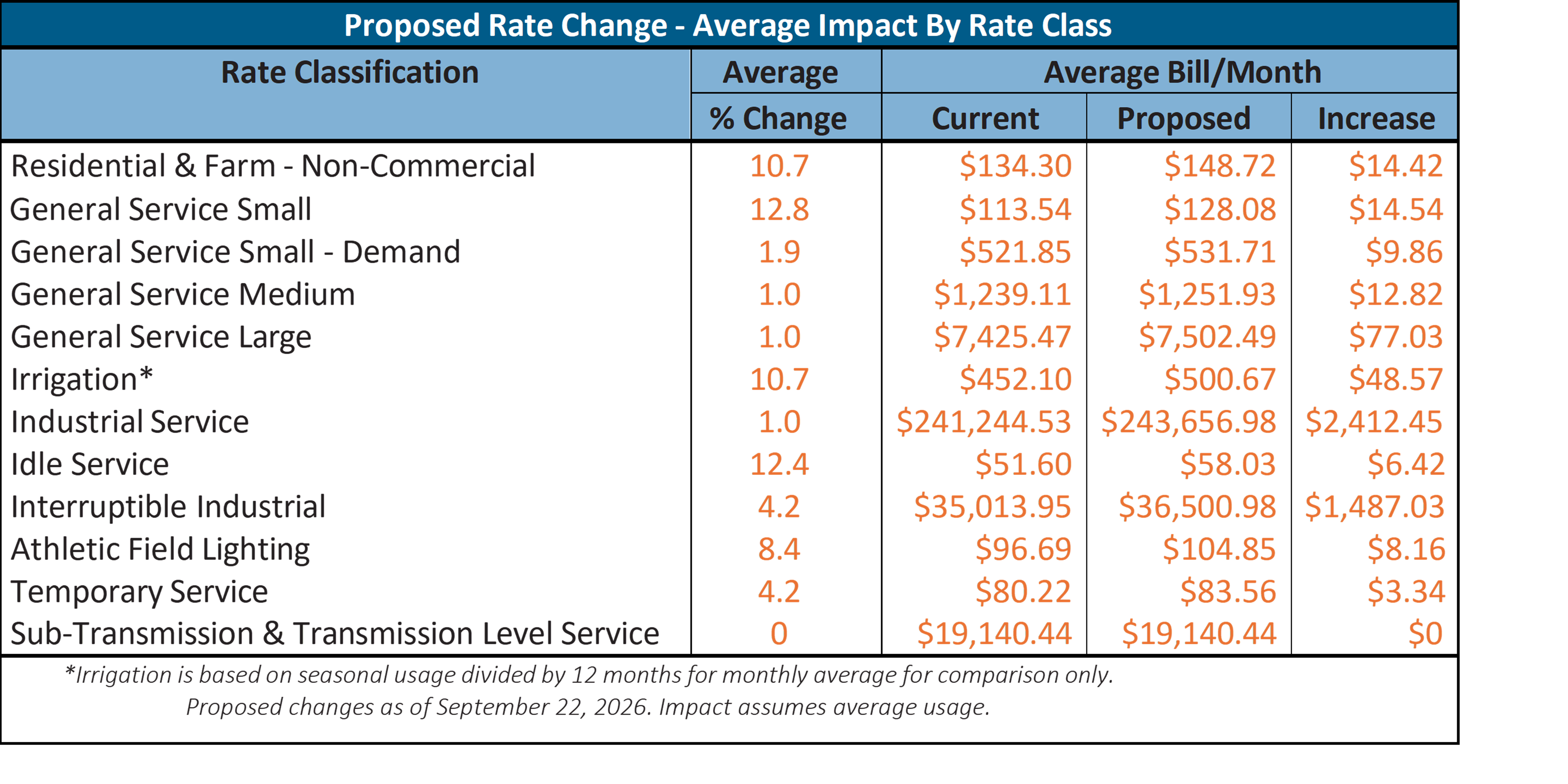
Because the cost of providing service differs among rate classes, the proposed adjustments vary and will not be the same percentage for all members. The table below shows the proposed impact for an average-usage member in each class; individual impacts will vary based on electricity use.
BALANCING COST AND RELIABILITY
We know changes to electric rates matter to household budgets, farm operations and local businesses. As a member-owned, not-for-profit cooperative, our responsibility is to control the costs we can, prioritize essential investments and weigh cost, safety, reliability and long-term value. For example, we are identifying opportunities to strategically modernize portions of our system rather than replace or upgrade infrastructure where it is not necessary. At the same time, many costs of maintaining the local distribution system — including materials, labor, equipment, and state and local taxes and fees — are outside our full control.
Learn more about how Prairie Land balances reliability, system investment and cost, and find more information about the proposed rate changes by clicking the links below: